Listener Crossword 4934: Solution Notes
Yet Another Sudoku by IOA
Puzzle explanation
This is one possible solution path. We’ll refer to the nine 3×3 sudoku boxes in normal reading order, ie box 1 at the top left, box 2 = top middle and so on to box 9 = bottom right. For individual cells we’ll use row-column notation, eg R4C1 is the 4th cell from the top in column 1 (the leftmost). To satisfy sudoku rules, no answer can contain 0 or have a repeated digit.
The 15ac clue says it’s 1ac×(1 + 0.8) = (9/5)×1ac, so 1ac must be divisible by 5; 0 isn’t allowed, so 1ac must end in 5, which is the first digit of 2dn. The clue for 2dn says 2dn = 1ac + (9/5)×1ac = (14/5)×1ac, so 2dn is a multiple of 14 between 500 and 599, ie one of {504, 518, 532, 546, 560, 574, 588}; eliminating the ones with 0 or a repeated digit leaves {518, 532, 546, 574}. The corresponding values of 1ac = (5/14)×2dn are {185, 190, 195, 205}; again, 0 isn’t allowed, and we can’t have 1ac = 185 and 2dn = 518 because there would be two 1s and two 8s in box 2, so 1ac = 195, 2dn = 546 and 15ac = 351.
In box 7 we have two squares, 10dn and 16ac, which starts with the last digit of 10dn. There are only 13 three-digit squares that don’t have 0 or a repeated digit, namely {169, 196, 256, 289, 324, 361, 529, 576, 625, 729, 784, 841, 961}. Interestingly, none of them starts with 4, none has 3 in the middle (the only 3s are at the start of 324 and 361) and there’s only one each with a middle digit of 4, 5, 7 or 9. Since 11dn is 2×5ac, the middle digit of 16ac is even. The potential pairs for 10dn and 16ac, sharing only the digit where they cross, are {196 & 625, 289 & 961, 529 & 961, 729 & 961, 841 & 169}.
9ac is some n to a power of 3 or more, sharing its last digit with 8dn, which is prime, so n ends with one of {1, 3, 7, 9}. 113 = 1331 is too big, so n is a single digit; we can ignore 1 (because raised to any power it’s just 1), and 9 because any power of 9 is also a power of 3. The powers of 7 are 73 = 343 (with a repeated digit), 74 = 2401 (too big) and so on, so we only need to check 3: its three-digit powers are {35 = 243, 36 = 729}. If 9ac is 729 then 8dn is a prime ending in 9 without any of the digits {7, 2} (in the same box) or {5, 4, 6} (in the same column, from 2dn), so its first two digits are from {1, 3, 8}. They can’t be 1 and 8 because any permutation of 189 is a multiple of 3, which restricts 8dn to one of {139, 319, 389, 839}. We can rule out 319 = 11×29 (not prime) and {389, 839}, which would make 6dn = 2×8dn one of {778, 1678}. So, if 9ac is 729 then 8dn is 139 and 6dn is 278. That rules out all of the options for 10dn and 16ac except 196 & 625; then 11dn ending in 2 means the prime 5ac = 11dn/2 ends in 1. Now 7dn is a square not containing any of {2, 7, 8} (in the same box) or 1 (in the same column), but that rules out all of the 13 allowable squares. Therefore 9ac isn’t 729, it’s 9ac = 243.
Now the prime 8dn ends in 3; its first digit is < 5 (or 6dn = 2×8dn would be too big) and can’t be 2 or 4 (in the same box) so 8dn is 1_3. To avoid a repeat in the box or column, the middle digit can only be one of {7, 8, 9}, but 183 is a multiple of 3, so 8dn is in {173, 193} and 6dn is correspondingly in {346, 386}. The 6 rules out 196 & 625 from the options for 10dn and 16ac; since 6dn contains either 4 or 8, 841 & 169 isn’t possible, which leaves {289 & 961, 529 & 961, 729 & 961} and in each case 16ac = 961. Now 11dn ends in 6, so 5ac ends in 3, and the 3s in 5ac, 6dn and 15ac mean there’s only one place for 3 in box 7, making 11dn 3_6. To avoid a repeat in the box or row, the middle digit is one of {2, 4, 7, 8}, ie 11dn is one of {326, 346, 376, 386} and the corresponding values for 5ac are {163, 173, 188, 193}. 188 is obviously not allowed, and 163 would put a second 6 in the same column as 11dn, so 11dn is one of {346, 386} with 5dn in {173, 193}, which are the same options as for 6dn and 8dn.
If 11dn is 346 then 6dn is 386 and the 4 in box 4 must be in 7dn, but 7dn can’t be 324 or 784 because 9ac already has a 4 in row 6, or 841 because 6dn has an 8 in the same box. Therefore 11dn = 386, 5ac = 193, 6dn = 346 and 8dn = 173. 10dn is now restricted to {529, 729}. The 8 in box 4 is now in 7dn, which is one of {289, 784, 841} but 7dn can’t contain 4, which is in 6dn, so 7dn = 289.
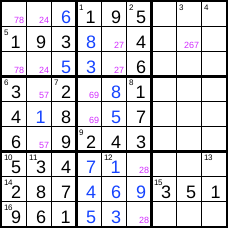
Box 7 is now missing only the digits {4, 5, 7} and 14ac is one of {284 = 2×2×71, 287 = 7×41}. In the SW-NE diagonal we have 98?2?1???, with a minimum sum of (9 + 8 + 4 + 2 + 5 + 1 + 1 + 2 + 3) = 35 and a maximum of (9 + 8 + 7 + 2 + 6 + 1 + 9 + 8 + 7) = 57, which can’t be as high as 71 to be a factor of 284. Therefore 14ac = 287 (and the diagonal sum is 41), making 10dn = 529 and R7C3 = 4 to complete the box. We can now fill in much of the grid by sudoku rules, as shown here (in blue). Note that 12dn = 163 is prime as required, though the clue wasn’t needed. To make the diagonal sum of 41, the three unknown digits in box 3 must add up to 12. They can’t be 129 (in some order) because 1 and 9 must both be in row 3; they can’t be 138 because R2C8 can’t be any of those digits; that leaves {147, 237, 156, 246}. For 3dn, the unused squares with 2, 6 or 7 in the middle are {169, 324, 361, 576, 625, 729} but the first digit can’t be 1, 5 or 6 (already present in row 1). If the middle digit is 2 then we need R3C7 + R1C9 = 10, which can’t be 1 + 9 (neither is possible in R1C9), 2 + 8 (repeating 2 in the box), 3 + 7 (because 3dn in {324, 729} uses either 3 or 7), or 4 + 6 (6 can’t be at R3C7 or R1C9). Therefore 3dn = 361 and the other diagonal digits are 2 and 4.
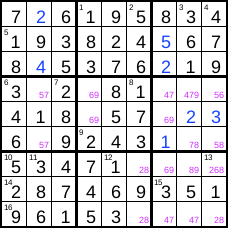
Now the only place for 9 in row 3 is in R3C9, and 8 must be in R3C1, making R3C5 = 7, R2C5 = 2, R1C1 = 7 and R1C7 = 8. Box 3 now needs 5 and 7 in R2C7 and R2C9, so the prime 4dn must be one of {259, 279, 459, 479}, but 279 and 459 are multiples of 3, and 259 = 7×37 is also not prime, so 4dn = 479 and we can do some more sudoku, as shown.
The NW-SE diagonal has two cells (R4C4 and R7C7) that contain 6 or 9, and they have to be different, or the two 6/9 cells in row 5 would have the same digit. The diagonal sum is therefore (7 + 9 + 5 + 6 + 5 + 3 + 9 + 5) = 49 plus the 2 or 8 in R9C9, ie it’s one of {51, 57}, both having a factor of 3. 13dn contains a 2; if it starts with 2 it has to be 218 = 2×10⁹ but the diagonal sum can’t be as large as 109. So 13dn is one of {612, 812}, but the diagonal sum is a multiple of 3, and 812 isn’t, so 13dn = 612 and the rest of the grid can be completed by simple sudoku logic.