Listener Crossword 4855: Solution Notes
Just the Job by Hedgehog
Puzzle explanation
This is one possible solution path. For 1dn = HE − AT, HE needs to be a two-digit number, so H ≥ 2. For 14ac = (DIR + T)(C − H)E(A + P) to be positive, we need C > H. Similarly, for 17dn = C(O − H)EREN + CI + E − S to be ≥ 1000, the first term must be positive, so O > H. Now, for 6dn = COCO + NUT, the first term is at least 34 = 81; but if C or O is any bigger the minimum is 32×42 = 144, too big for the two-digit entry. Therefore, C = 3, O = 3 and H = 2.
Now 9ac = 27T for a two-digit answer, so T is one of {1, 2}. If T is 2 then 8ac = M + 2(AI)2 for a two-digit answer, which needs AI ≤ 7, and since both 2s and 3s have been allocated, either A or I must be 1 (with the other in the range [4, 7]). But if A is 1 then 22dn = P − R − T can’t have two digits, and if I is 1 then the maximum for 4ac = N(F + 2) − A is 9(9 + 2) − 4 = 95, too small for the three-digit entry. Therefore T isn’t 2, ie T = 1, which makes 9ac = 27; and 4dn = B + E − 1 = _7 must be 4dn = 17 with B = 9 and E = 9.
We now have 8ac = M + (AI)2, so AI ≤ 9. Neither A nor I can be 1, for the same reasons as above, 3 has already been assigned to two letters, and only one 2 is available, so {A, I} = {2, 4} (in either order), making 8ac = M + 64, in the range [64, 72]. For 1dn = 18 − A to end in 6 or 7, we must have A = 2, 1dn = 16 and I = 4. For 8ac to start with 6, M is one of {0, 1, 4, 5}.
Now 6ac = 81 + 4GN and 6dn = 81 + NU, both with two digits, so both 4GN and NU are < 19. For 4ac = 4(N(F + 1) − 2) to be ≥ 101 (from the grid), N must be at least (101/4 + 2)/(8 + 1) ≈ 3.03, so N ≥ 4. U can’t be 0, or 26ac = FUN would be 0; if it’s not 1 then NU is at least 4×5 = 20, too big. Therefore U = 1 and N is in the range [4, 8]. For 4GN to be < 19, G is at most 19/4/4 ≈ 1.2 and the only available digit is G = 0, which makes 6ac = 81 and 11ac = 18. That completes 6dn = 88 in the grid, which makes N = 7.
From the grid, 4ac = 28(F + 1) − 8 is in the range [101, 199], so F is between (101 + 8)/28 − 1 ≈ 2.9 and (199 + 8)/28 − 1 ≈ 6.4, ie one of {4, 5, 6} (as both 3s are taken), making 4ac one of {132, 160, 188}, so 5dn starts with 2 or 8 (not 0). 5dn = 162R + 1 has three digits, so R can’t be 0 and is at least 4, which means 5dn can’t start with 2, so it starts with 8, making 4ac = 188 and F = 6, which makes 26ac = 42. 5dn is in the range [810, 819], so R is approximately 814/162 ≈ 5.02, ie R = 5, making 5dn = 811, 24ac = 89 and 15dn = 5404.
In the grid we have _2 for 22dn = 4P − 6, so P = 7, making 22dn = 22, 23ac = 98 and 2dn = 2462. That completes 8ac = 64, so M = 0, which makes 16ac = 258. Now we have 2_ for 22ac = 3W + 7. The available values {4, 5, 6, 8} for W would make 22ac one of {19, 22, 25, 31} respectively, which are all out of range or a duplicate of 22dn, except 22ac = 25 with W = 6.
19ac = 855D has to match 4___ in the grid, and the values available for D are {4, 5, 8}; the only one giving a multiple starting with 4 is D = 5, making 19ac = 4275, as well as 1ac = 1222, 14ac = 8181, 15ac = 522, 19ac = 4275, 28ac = 8885, 20dn = 752, 23dn = 93 and 25dn = 95.
For 3dn = 38S2 we have 2__2 in the grid, and the available values for S are {4, 8}; 38×42 = 608 doesn’t fit, so S = 8 and 3dn = 2432, as well as 27ac = 223, 7dn = 1710, 13dn = 956 and 17dn = 8518. L and V are now {4, 8} in either order. For 17ac = 180V + 160 we have 8_0 in the grid; 180×8 + 160 = 1600 is too big, so V = 4, making 17ac = 880. That leaves L = 8, which makes 12ac = 36329, 21ac = 68589, 9dn = 22251, 10dn = 88888 and 18dn = 8888.
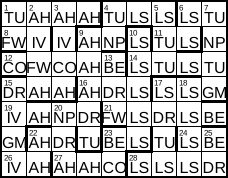
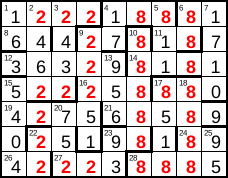
We now have the complete grid shown here, alongside the letter options for each cell. Most of the columns don’t have letter choices that can produce anything sensible, but the left, middle and right ones do. It doesn’t take much trial and error to spot TWODIGI / TPERFEC / TNUMBER, ie “two-digit perfect number” in them. A perfect number is one that is the sum of all of its divisors (except itself), and the first ones are 6 = 1 + 2 + 3, 28 = 1 + 2 + 4 + 7 + 14, 496 and 8128. The only one with two digits is 28, and all the 2s in the grid form a 2, while all the 8s form an 8, so highlighting those digits forms the required 28.